
A legacy of learning
– How my mum’s experience shaped a lifetime of education
When my mum was 5 years old, she missed the test day at primary school and was mistakenly placed in a remedial class. That experience marked her and fuelled a fierce determination that her children would get the education she'd been denied.
Going to university was always my mum’s ultimate goal for my brother and me. Growing up, her determination translated into something profound for my brother and me: a commitment to self-directed learning from a young age. She encouraged us to become curious, capable learners unafraid to teach ourselves what we needed to know. That practice has never left me.
Once I’d finished university and entered the workforce, the self-directed learning my mum instilled came into its own. As an adult, I have found learning most essential during transitions, when what worked before no longer fit and I needed to consolidate where I’d been in order to figure out where to go next.
That journey started soon after arriving in Australia with Sydney Leadership in the early 2000s and then to Harvard to dig deeper into Adaptive Leadership. Later online ACUMEN courses, the intensive five-day Australian Institute of Company Directors and a Global Executive MBA at the University of Sydney provided new knowledge, and a space to consolidate and reflect.
Each course helped me see patterns in decades of grassroots work and provided frameworks to understand and articulate what I'd been doing intuitively all along. It showed me how 30 years of practice and leadership in the for-purpose sector, with a particular focus on giving and philanthropy, had built deep expertise worth sharing.
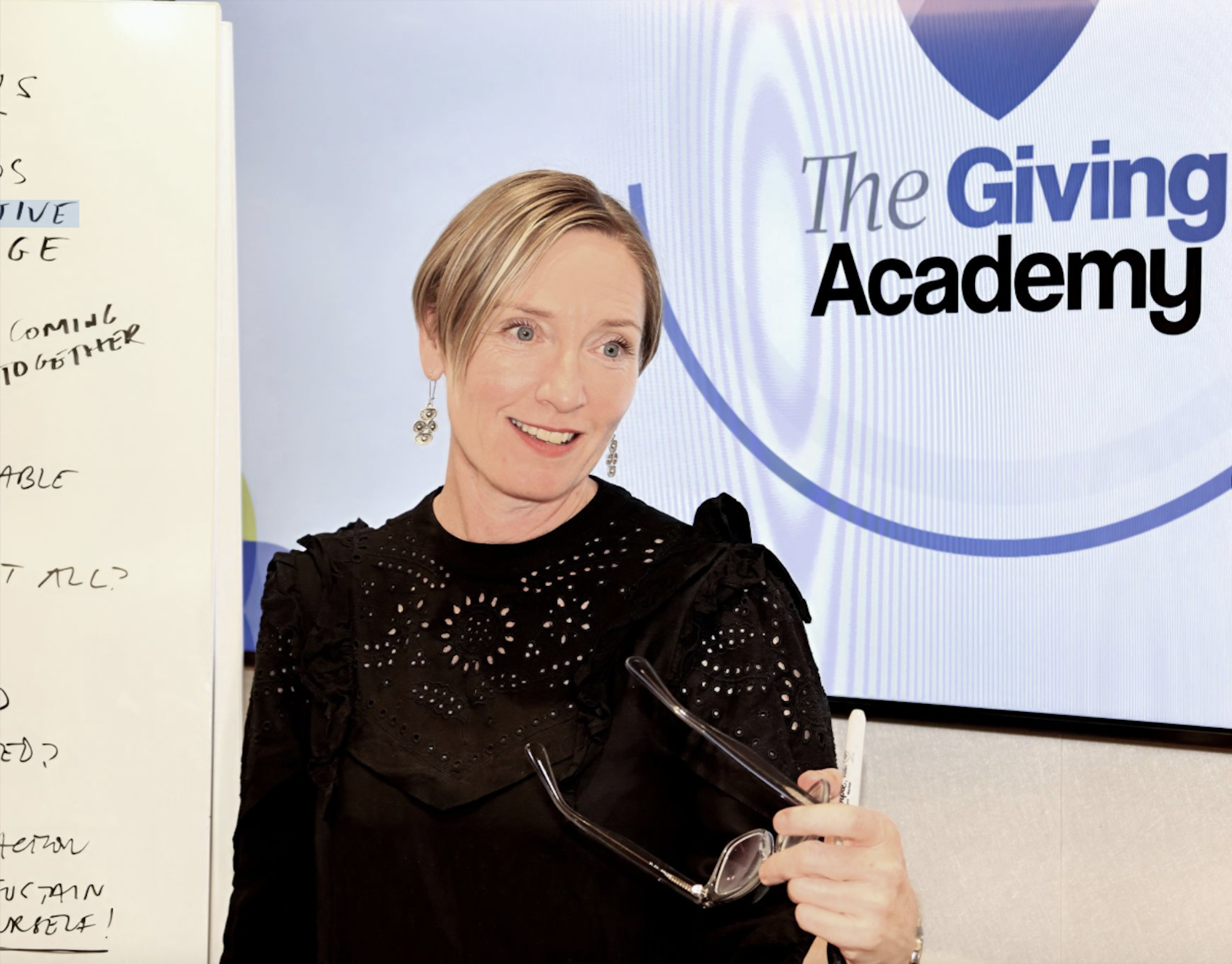
Jo facilitating The Giving Academy Advanced Pilot 2025.
Now, as Adjunct Professor at UNSW Business School, leading The Giving Academy at the Centre for Social Impact, I am the legacy of my mother's determination. And as my own kids start to ponder which university they’ll go to, as if it's the most natural thing in the world, I'm reminded of how far we’ve come.
I was the first in my family to go to university, but I wasn't the last. My brother went next and finally my mum. She did an access course and went on to study history at Manchester University, before forging a successful career helping other smart adults with their literacy and numeracy; adults the mainstream system had let down. Our family's relationship to learning has truly come full circle.
Leading The Giving Academy, I find myself doing for others what education did for our family. People typically come to philanthropy with significant experience and expertise from their successful careers in other disciplines. They bring valuable skills, and often an assumption that philanthropy is a niche, emerging field without its own body of knowledge, where every challenge is a world first that’s never been tackled before.
That assumption can be costly, in time, money, and impact! The Chan Zuckerberg Initiative, The Gates Foundation, even Jamie Oliver when he started Fifteen back in the day, have all publicly acknowledged that their unchecked assumptions about how change happens have been costly in multiple ways and affected people's education, jobs and futures.
The Gates Foundation’s $575 million teacher effectiveness initiative, one of the most ambitious education reform efforts in recent history, showed no gains for students after seven years.[1] Despite massive investment and involvement of three large school districts and four charter networks, researchers found no evidence of widespread positive impact on student outcomes.[2]
In the CEO’s 2016 annual Gates Foundation letter, Sue Desmond-Hellmann acknowledged what went wrong: ‘We missed an early opportunity to sufficiently engage educators – particularly teachers – but also parents and communities.’[3] The lesson was clear: even with enormous resources and good intentions, assuming you can solve problems without drawing on existing expertise and community knowledge can lead to expensive failures.
Philanthropy and giving have a vast history, deep expertise, and global evidence base. In our Effective Giving and Giving in Complexity courses, we work with people to understand that there are proven ways of giving well, regardless of their particular focus, if the goal is to create lasting impact rather than perpetuate the status quo with all its inherent bias, discrimination, and barriers that block particular cohorts and communities from thriving. It's grounded in the reality of Australia's philanthropic sector while drawing on global knowledge and real examples. It’s about supporting people to use the expertise they already have, connect their isolated experiences to broader patterns, and leapfrog the mistakes we repeat when we don't learn from each other.
My mum never got the education she deserved on that first attempt, but she refused to accept that verdict. She went back, studied, and built a career devoted to helping others who'd been similarly failed by the system. She gave me something more valuable than just the expectation of university: the understanding that learning isn't just what happens in a classroom on a particular day when you’re meant to take a test. It’s a practice, a commitment, a way of moving through the world that opens doors even when they’ve been unfairly closed. Being open to continuous learning is an integral part of contributing to transformational change.
[1] RAND Corporation evaluation, 2018; Education Week, An Expensive Experiment: Gates Teacher-Effectiveness Program Shows No Gains for Students, June 2018
[2] RAND Corporation, Continuing the Search for Valid and Reliable Measures of Teacher Effectiveness, 2018
[3] Gates Foundation CEO Annual Letter, 2016
