
The bromance, the bronze medal and the sorceress who ate the room
A CEO said something to me recently that was a gut punch. Their fear, and their assumption, is that funding charities has become a form of entertainment for wealthy people.
Once they’d said it, I couldn’t stop seeing it. The pitch decks dressed up as intimacy, the funding rounds run like reality television eliminations or gladiator bouts, the endless, exhausting choreography of proving worth to people who have already decided what they think worth looks like. All of it performed in the name of making sure every dollar lands well, which is a very efficient way of ensuring that almost no dollar lands at all, because everyone is too busy performing to actually build anything.
Competitive philanthropy has been going on since funders worked out that giving money away could also be a way of keeping hold of it. That reflection sits inside something bigger I’ve been noticing all winter, or summer depending on which hemisphere you live in. There is a real hunger, in rooms that have nothing to do with each other, for something other than the world we’re currently being sold. People are tired of performance standing in for substance. And every so often, in unlikely places, you get a glimpse of the alternative.
Take the World Cup, an institution that has given us more cynicism per square metre of turf than almost any other human endeavour. And yet. England beat France 6-4 in the bronze final in Miami, an unhinged scoreline for a match neither side wanted to be playing. Didier Deschamps said as much before kickoff. Kylian Mbappé went and broke the World Cup scoring record anyway, because apparently even players who don’t want to be there still want to win, which tells you something about competitive instinct that no motivational poster ever will. And when it was done, when Jude Bellingham had handed the penalty to Saka so he had the chance of his hat-trick, and then calmly sealed it at 6-4 after Ousmane Dembélé’s stoppage time strike had briefly threatened English composure, there was no loathing in any of it. Two exhausted teams, historic rivals, centuries of mutual suspicion between their countries, shaking hands and hugging each other like men who respected what the other had just put themselves through.
Which is not a small thing. English football’s relationship with masculinity has not historically been a source of civic pride. We have spent decades exporting a version of male competitiveness that curdles fast: the pundits screaming, the message boards frothing, the sense that every match is a referendum on national character. And don’t get me started on the St George’s Cross. Yet here were Bellingham and Erling Haaland, forged as teenagers together at Borussia Dortmund, calling each other’s names across a quarter-final and meaning it kindly, Haaland telling anyone who’d listen that Bellingham doesn’t deserve the criticism he gets. None of this fixes anything structural. It’s a football tournament, not a social movement. But it is a small, visible rebuke to the version of manhood currently being marketed to teenage boys by people with podcasts and grievances, and I’ll take it.
Then there’s Circe. Samantha Morton turns up about halfway through Christopher Nolan’s Odyssey, has maybe ten minutes on screen, and walks off with the entire film. Nolan has compared the crew’s reaction to what happened around Heath Ledger on The Dark Knight, which is the sort of thing directors say to sell tickets, except in this case everyone seems to agree he’s right. Morton’s Circe, like Madeline Miller’s novel before it, refuses to let her be merely a temptress toying with sailors for sport. She is a woman who has watched what men do when unwatched, and built her defences accordingly. Miller was explicit about this when she wrote the book. The mythology we inherited about seductive, dangerous women was mostly written by men explaining away their own violence. Strip that back and there is no monster left, only power, and who gets to hold it, and what happens to women who take some of it for themselves.
I’ve read the criticism that Nolan doesn’t give enough film time to the women in the poem, and I’m less troubled by it than I expected to be, for two reasons. One is that Emma Thompson is reportedly writing a script for Pat Barker’s The Silence of the Girls, which should do exactly what this film doesn’t. The other is that Nolan’s interpretation treats the Trojan Horse as the founding document of bad faith. A gift that was actually a weapon, offered in the language of peace, built entirely on the fact that the other side would trust the wrapping. You can draw a fairly straight line from that wooden horse to every subsequent collapse in the rules of engagement, in war, in law, in the smaller wars we fight inside marriages and workplaces and boardrooms. Once you’ve established that the point of language is to disguise intent rather than reveal it, you’re already living in a post-truth world. The Greeks just got there roughly three thousand years before we did.
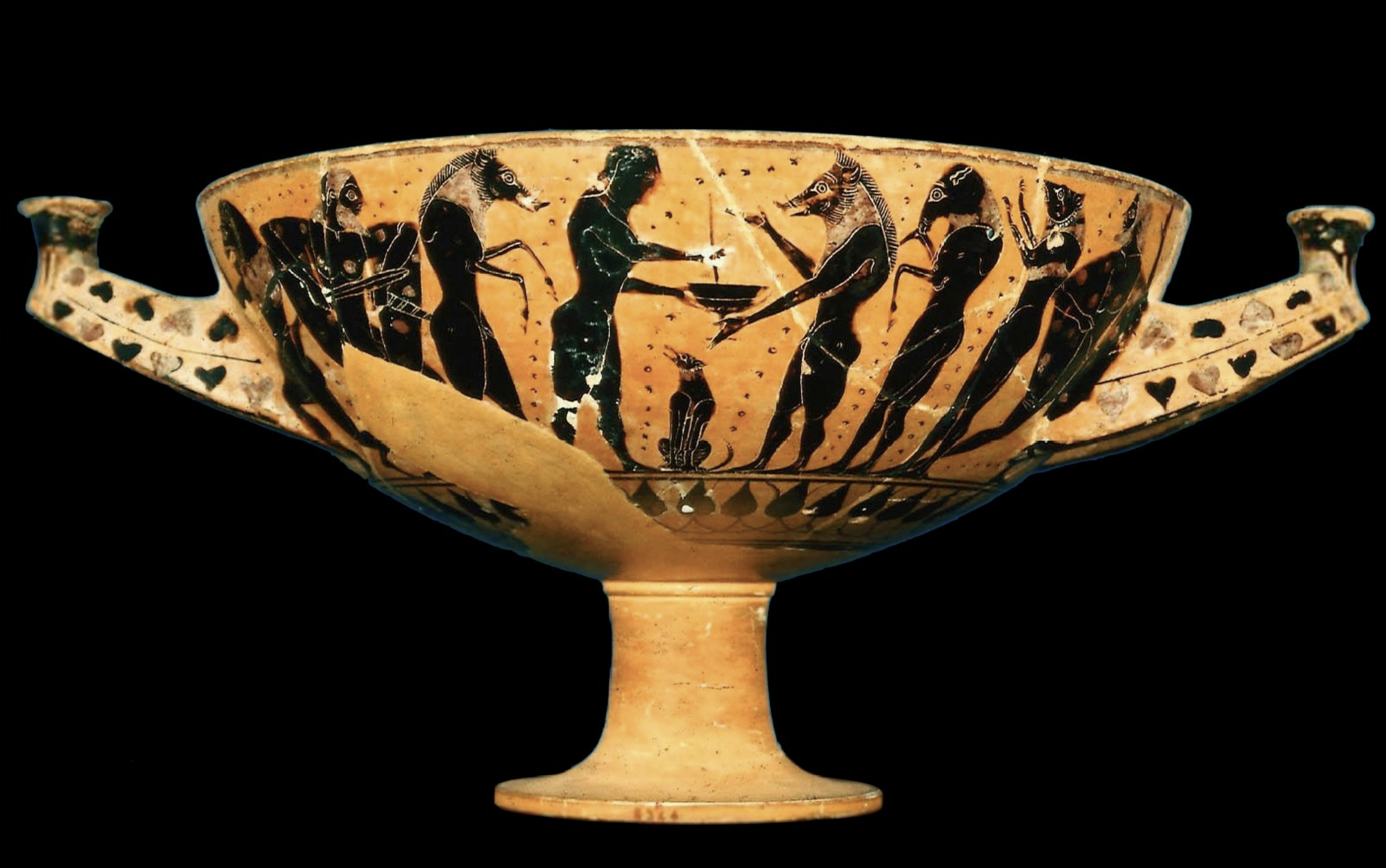
Drinking cup (kylix) depicting scenes from the Odyssey, Painter of the Boston Polyphemos, about 560–550 BC. Museum of Fine Arts, Boston, 99.518. Photograph by Lucas, Ancient Art Podcast, via Wikimedia Commons, CC BY 2.0.
Closer to home, or my original home at least, there’s Michael Marmot’s continuing work on the social determinants of health, suddenly relevant well beyond Greater Manchester, because Andy Burnham is now Prime Minister. It is disorienting to watch a mayor whose whole pitch, laid out in the Build Back Fairer framework he commissioned from Marmot’s team back in 2021, was rebuilding trust in the fabric of ordinary life, become the person now steering the entire country’s fabric. Whether he can do that at national scale is a different question. But the note he opened on as Prime Minister was regaining our stability, rather than any vision of growth or greatness, and that tells you what he thinks people are starving for. I don’t use that word lightly.
Which brings me back to where I started, because I think that’s the actual thread here, running through the football pitch and the film screen, Whitehall and the funding meetings I sit in every week. People keep telling me, in different words, that they are worn out by control, dressed up as care, and by competition standing in for partnership. I’ve had more conversations this month than I can count about where our individual lines are, where mine used to be, where I’ve let it slide, where I need to redraw it. It would be easy to feel paralysed by the scale of what’s wrong. I don’t have the bandwidth to lead every fight that matters right now, and neither does anyone else.
But I do have capital. Social, reputational, structural, and whatever knowledge I’ve built up over twenty-five years of watching money move well. So the question I want to ask myself isn’t whether I’m doing everything. It’s whether I’m really putting what I’ve got behind the people who are. I hope it’s a useful question for you too, as we all pick our way through this shitshow.
This blog is part of PRISM’s ongoing series, What the Evidence, Expertise and Experience Says.
