
How do you measure impact when your theory of change operates at the level of policy, market behaviour and institutional norms, and your contribution varies from one piece of work to the next?
That was the challenge Kristy Graham was grappling with when she proposed that the Australian Sustainable Finance Institute (ASFI) and PRISM work together on building learning practices and identifying the outcomes ASFI was contributing to. Last month ASFI marked five years of work and launched its first Impact Report, the product of that year-long learning partnership.
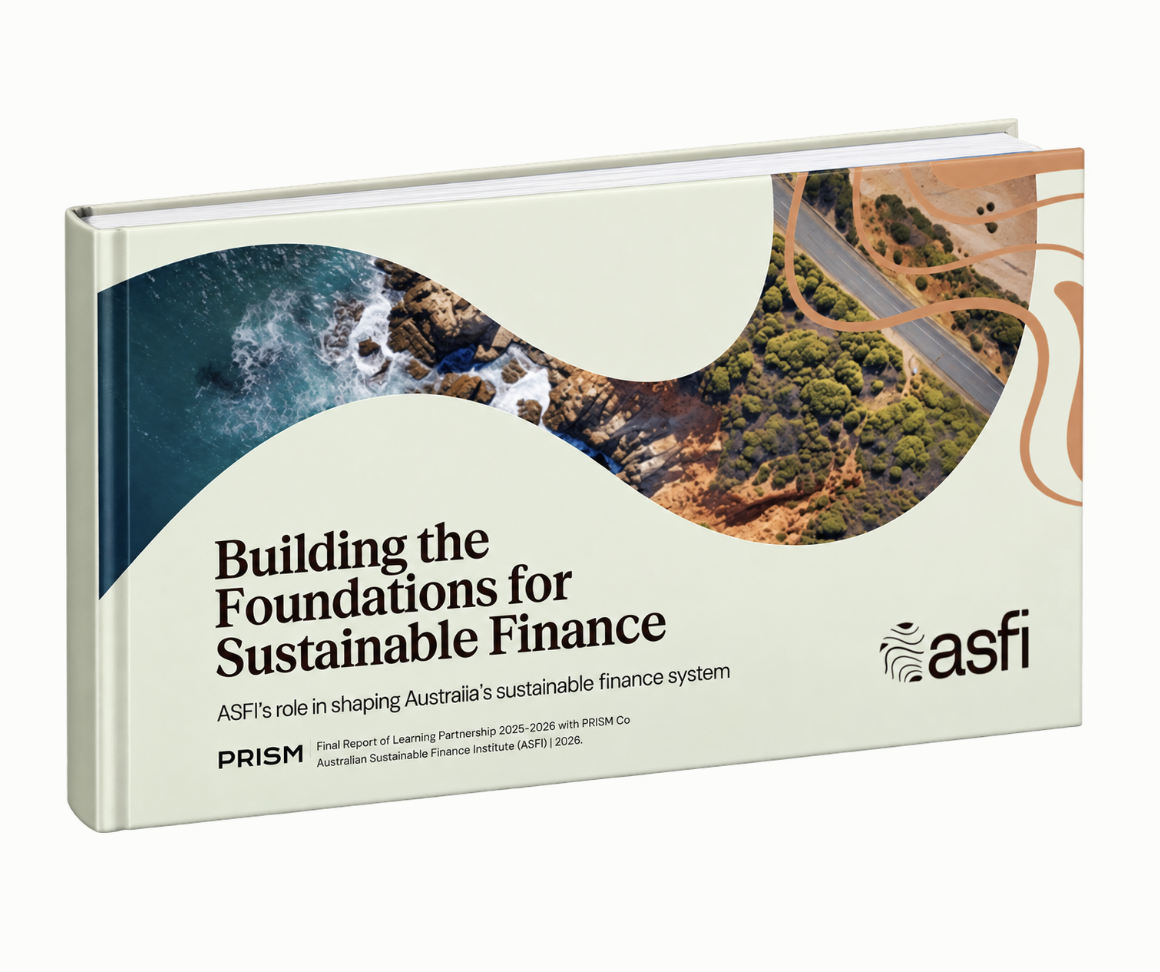
ASFI is typical of many organisations we work with. It plays a catalytic role in a collective effort to shift some of the fundamental ideas, relationships and practices that shape how things currently work, in this case how money flows and what it flows to. If more finance in Australia is sustainable, it is actively supporting positive environmental and social outcomes, such as reducing emissions, valuing nature and giving people who have previously been excluded access to finance.
Like many such organisations, ASFI works across many parts of the system, particularly on new forms of dialogue, collaboration and change with the finance sector, government, First Nations leaders and civil society. Kristy and her team were holding their own important questions about their contribution and role, and how to adapt both over time to make the most systemic and sustained contribution to change.
In our experience, that orientation to the process really matters. When an organisation’s learning agenda is driven by its own questions about contribution and role, the learning can change how it understands itself in the broader system. Often those questions come from outside, as funder requirements. That wasn’t the case here.
Our learning partnership had two strands. The first created a new framework to help ASFI identify changes other actors had made that ASFI’s work had contributed to. Drawing on documents, sessions with the team and verification interviews with 16 external stakeholders across finance, government, First Nations leadership and civil society, we identified and analysed 179 outcomes. They relate to changes in financial institution practice, in policy and regulation, and in leadership.
The second strand was a series of learning workshops with ASFI’s team. These fed into identifying and collecting outcomes, and tested different practices for noticing and making sense of systems dynamics to support the team’s nuanced work.
As we went, the workshops and external interviews also shaped ASFI’s thinking about its current practice and direction. We could see the team applying what it was learning in real time.
The work also tested the strength of ASFI’s relationships and feedback loops. As an independent party, we could hear things people might not say to ASFI directly. What they told us largely confirmed what ASFI was already hearing, with only small nuances added. ASFI’s partners had been giving it honest feedback all along.
Any organisation playing a role like ASFI’s knows how hard it is to make sense of what’s changing and how you’re contributing alongside others, and to keep adapting and articulating your role in the system over time. ASFI is continuing the practices we started together. It is an example of how understanding your contribution to impact requires investing in the conditions for learning, in your organisation and your field, and not just in delivering outputs, whether those are your own or the impact report.
If you’re doing complex work or moving through a transition, and looking for spaciousness, stimulation and community to think through what you’re grappling with, consider joining our Community of Practice.
Thanks to Courtney Collins for editing and Kristy Graham for reviewing to make sure we got the story right.