
When the evidence is clear and we change anyway
Something sits uncomfortably at the heart of this series. We’ve been making the case through recent blogs that the evidence for long-term, unrestricted, relationship-based funding is robust, consistent, and growing. And it is. But there’s a question we’ve been circling without naming directly.
If the evidence is this clear, why do funders keep changing strategies?
Ford Foundation ends BUILD
In late 2025, just as Ford Foundation President Darren Walker was preparing to hand over to incoming president Heather Gerken, Ford ended BUILD, the $2 billion initiative whose independent evaluation we wrote about recently. Walker himself described the program as a success. The independent evaluation by NIRAS had returned consistently strong results across multiple phases. Grantees were shown to be more resilient, more financially stable, and more effective in their work.
The reason given was about leadership. Walker, speaking in his final weeks as Ford’s president, just before Gerken's arrival in November 2025, told the Chronicle of Philanthropy: “As I look at transitioning and passing the baton to Heather, the opportunity is to create the space for her to begin to imagine what will come after BUILD.”
We want to be careful here. Leadership transitions are real and legitimate moments of institutional change. New Chairs, or CEOs in Australia, need space to lead. And Ford has committed that the principles of BUILD, the flexible, long-term support, will be embedded across its broader grantmaking going forward. We hope that’s true.
But the organisations that built five-year plans on the basis of BUILD’s model, that reorganised their leadership, their data systems, their theory of change around the security it provided, are now navigating a different reality. And the sector is left watching a program with strong evaluation results wound down merely because leadership changed.
Kris Putnam-Walkerly, a consultant who advises foundations, told the Chronicle of Philanthropy that departing leaders often clear space for whoever comes next, rather than locking in their own commitments. But she questioned why Ford was stepping back from BUILD when the program had been working well. She warned the move may deepen the frustration nonprofits already feel toward foundations that change course rather than sticking with a plan. As she put it, “philanthropy is already slow enough, and this just adds years of delay.”
The same dynamic is playing out closer to home but with much less fanfare.
Westpac Foundation pivots from social enterprise to education
The Westpac Foundation has been one of the most consistent and serious funders of Australia’s social enterprise sector for more than 20 years. They have funded organisations, invested in the field: in intermediaries, in research, and in the conditions that make a sector possible rather than just individual organisations within it.
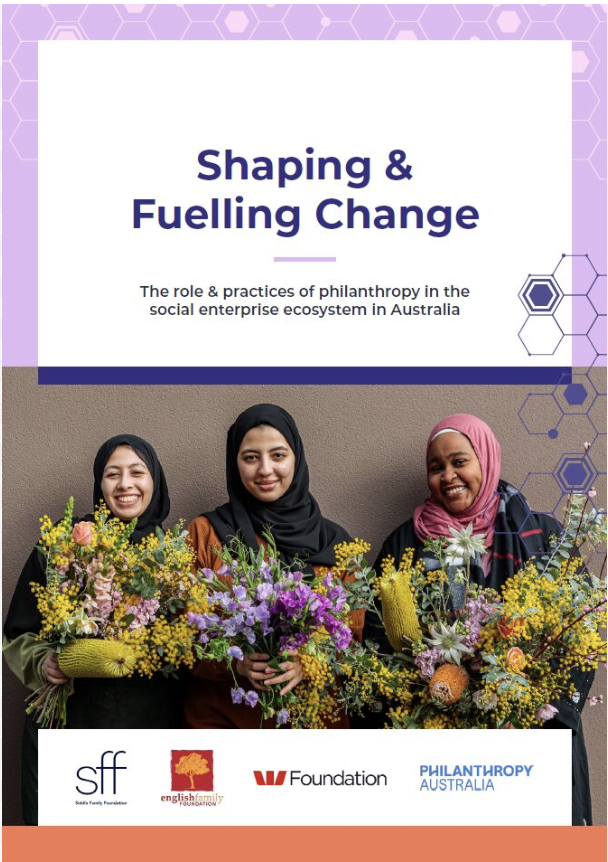
Shaping and Fuelling Change, a new national report, led by May, examines the role of philanthropy in Australia’s social enterprise ecosystem. The research found that Westpac made a meaningful contribution to the development of the ecosystem over time in a number of ways.
This year, Westpac announced it is uniting all four of its foundations (Westpac, St George, BankSA and Bank of Melbourne) under a new unified strategy. The focus: improving literacy and numeracy outcomes for children facing disadvantage. That is genuinely important work. The pivot is publicly framed as a deliberate choice to concentrate collective impact.
But the shift away from 20 years of sustained, field-building investment in the social enterprise sector is a sector event. It changes the funding landscape. It leaves gaps that are hard to fill quickly, particularly for smaller, more experimental organisations that depended not just on Westpac’s money but on its understanding. The kind of understanding that only comes from two decades of sustained relationship.
What this tells us
We’re not writing this to criticise Ford or Westpac. Both have made significant, genuine contributions. Both have been more thoughtful about their funding practice than most. And both are making decisions that are understandable within their own institutional logic.
But that’s the point.
Funder strategy changes are often driven by institutional logic: leadership transitions, board preferences, the desire of new leaders to make their mark, the natural cycle of organisational renewal. Not by evidence about what works. It’s a structural reality rather than a moral failure. And it has real consequences for the organisations and sectors that build their futures around funder commitments.
The research we reviewed in the previous three posts is consistent on this. What enables organisations to think clearly, learn honestly, and work toward change over time is not just unrestricted funding. It’s the predictability of that funding. The confidence to plan. The freedom to take risks because the floor won’t disappear.
When funders change course, even for good reasons, that confidence goes with them. And the cost is borne almost entirely by the organisations and communities on the receiving end, not by the funders themselves.
There is no easy answer here. But the sector deserves an honest conversation about what strategy change actually costs, who absorbs it, how long recovery takes, and what gets lost in the gap.
“The premise guiding BUILD was that social justice organisations need secure, long-term support so they can develop into sustainable institutions that can weather droughts in funding and periods of economic instability.”
– Chronicle of Philanthropy, November 2025
That premise hasn’t changed just because the program ended. The need is still there. The evidence is still clear. And the organisations are still waiting.
This is the third post in our series What the Evidence, Expertise and Experience Says. Written by May Miller-Dawkins and Jo Taylor, edited by Courtney Collins.
Next week we turn from the global evaluations to the Australian field, starting with what 25 years of philanthropic investment in the social enterprise sector taught us when we actually asked.