
Action Learning looks simple. One person brings a live challenge, a small group asks questions, and nobody gives advice. But in practice, it asks much more.
We have both been facilitating Action Learning Sets for more than twenty years, with funders, advocates and leaders across civil society, and with artists and writers. Over that time, Action Learning has changed how we lead, listen and decide.
The biggest challenge of Action Learning has also been the most freeing for us: we no longer have to solve other people’s problems. The person who owns a problem knows its history, politics and the people it affects far better than we ever will. So our job as facilitators is to ask open, curious questions, and to hold the group to asking them too. That way, the challenge owner reaches their own insight and chooses their next best action.
Action Learning has also changed how we see things that don’t go to plan. We now understand learning as a cycle of action and reflection, repeated for as long as an issue stays unresolved. All action involves risk, and some of it will not go the way we hoped. Accepting that makes it possible to act at all. For Courtney, Action Learning was the way out of a paralysis of overthinking and the procrastination of endless planning. For May, it was getting better at noticing things as important information, rather than pushing too hard for particular outcomes. If something doesn’t go to plan, we reflect, revise and act again.
And it has taught us to consider power dynamics before content. Who sits with whom shapes a program more than any agenda. Before a learning group starts, we ask who might feel unable to speak. An Action Learning Set needs a live challenge the person actually owns, peers rather than a hierarchy, confidentiality the group keeps, and members who turn up. A facilitator can hold a safe, well-structured space and point to the value of discomfort. But choosing to stay with it is up to each person in the room. That is often where the method meets its limits.
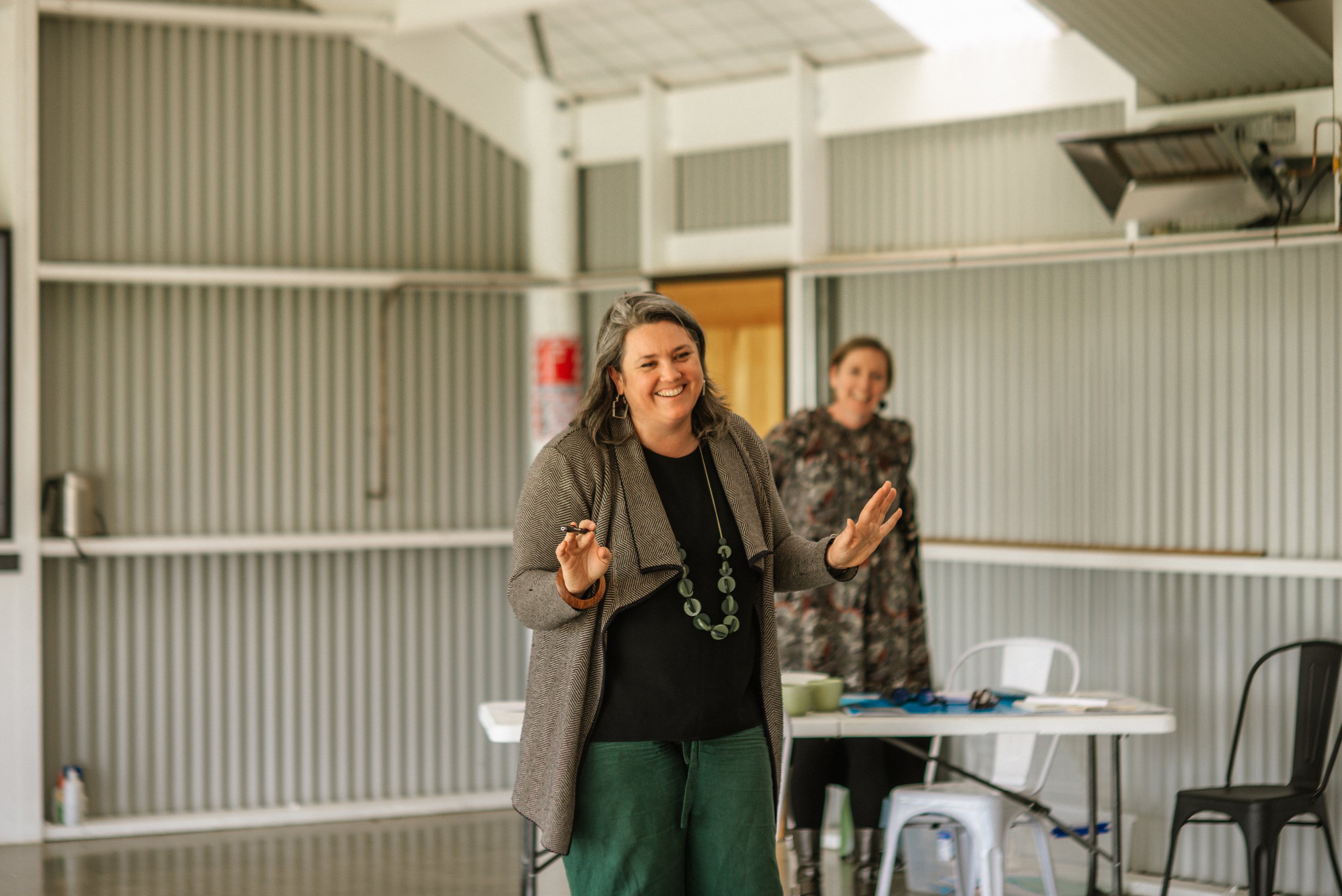
May Miller-Dawkins experiencing the liberation of Action Learning, a method that preferences open and curious questions over advice-giving.
A common limit is the habit of advice-giving. We see it most in experienced people, many of whom have built careers on having the answer. Their advice often comes wrapped in a question: “Have you thought about x?” It may well be good advice, but it reflects the questioner’s situation more than the challenge owner’s, and it can move the challenge owner from thinking to defending. Mostly, people learn to hold back once this habit is named. But the method does not suit those who experience holding back their expertise as a loss of status, or as a discomfort they can’t bear.
Action Learning also needs truth-telling. The challenge owner has to bring a real challenge, with all of its attendant cringe. In philanthropy and civil society, many of us are trained to tell the impact story for grant reports and board papers. Bring that polished version to a Set and you get tidy questions back. There’s no space for learning, and nothing moves.
Another limit is being unable to own failure, or to talk about it. The cycle depends on people coming back and saying what happened, including the parts that went badly. You can usually tell when someone can’t: the challenge is always somebody else’s fault, every return visit reports progress, and the subject changes when a question gets too close to the bone.
We understand why: funding and reputation depend on looking like things are working. But there’s no faking it until you make it in Action Learning. The clearest sign the method is working is when someone says: “I tried it and it didn’t work. But here’s what I learned...”
If you’d like to learn this practice alongside others, come and join PRISM’s Community of Practice. You can try it first at our free taster session on Thursday 26 November at 11:30am (AEDT): register here.