
We were recently training a team in Action Learning facilitation. They support learning across part of the health system in Australia, and over a few sessions together we experienced Action Learning, explored it as a practice and began to deepen their facilitation skills.
Then one of the team asked:
When is setting up an Action Learning Set the right approach, and who should be in it?
By a Set, we mean a group that meets regularly to do Action Learning.
The question mattered for this team. They sit within a national peak body, working with diverse member organisations across the country on many areas of learning, and inside the dynamics that exist in a broad movement and sector. Who sits together in a Set shapes what people are able to say. We thought our answer was worth sharing more widely.

An Action Learning Set at a Haven Retreat, Bellingen, Gumbaynggirr Country, NSW.
As is probably obvious, we are huge believers in the power of Action Learning. We have both been facilitating Action Learning for more than two decades. We keep returning to it as a practice because it gives people important space for deep reflection that can lead to considered action, and offers a way to build stronger understanding and relationships across different systems. Over that time we have witnessed people grow more courageous in their decision-making.
However, there are some important conditions that need to be in place for this to happen.
Our Sets usually bring together 6-8 people, sometimes a few more, who meet monthly for 90 minutes in a confidential and facilitated space.
A Set flourishes when there is trust, diversity and connection. Some of that is created by the facilitator. But much of it comes down to who is in the room.
When we convene a Set, our starting formula is: point of commonality + diversity.
A Set needs a reason to come together. That shared ground might be a role, a style of practice, an issue, a sector or areas of interest. Some of our past Sets have been for Advocates, Artists and Writers, Social Entrepreneurs, Peer Counsellors or Navigators, CEOs and Field Catalyst orgs, or convened around Systemic Practice, Natural Resource Governance, Youth Wellbeing in a particular region and Financing for Affordable Housing. We’ve set these up through networks of partners, existing coalitions or networks, as part of Fellowship Programs of Philanthropic Foundations, or through groups of individuals coming together.
Once the point of commonality is established, part of what supports Action Learning is diversity of people and perspectives. Open and curious questioning sits at the heart of the practice. When people come from varied places, personally and philosophically, they are curious about different facets of what someone is facing. Together they can help that person stretch their thinking, imagining or reflections much further than they could alone.
In many of our groups, we find real value in the diversity of people and organisational contexts. There is both solidarity and real insight gained from hearing deeply about the experiences of an advocate working in a completely different arena or of actors involved in financing affordable housing who play distinct roles in the system.
Beyond the point of commonality + diversity formula we need to attend to power and other dynamics at play. In a Set within a sector, network or system we only include one person per organisation (with a few exceptions such as co-CEOs) so that people can speak freely within a confidential space separate to their organisations. We tend to look at whether we need Sets to have similar levels of experience or roles, or whether a mixed group will serve everyone’s learning. Similarly, in parts of our work with The Giving Academy, we facilitate mixed groups of funders and civil society organisations they may fund. We try to balance out numbers and be explicit about the issues and dynamics that may and do come up.
Through all of this, careful facilitation and the confidentiality rule do a lot of heavy lifting alongside the curation of the group itself. What is shared in the Set stays in the Set. The facilitator keeps the structure of each session, makes sure questions stay open and curious, and holds the line on advice-giving.
This gets trickier when setting up a Set within an organisation. The cultural context has a deep effect on how safe people feel to bring forward complex issues and be vulnerable and honest. We’re increasingly seeing self-organised groups working well in some settings where people who have experienced Action Learning elsewhere are able to keep the practice alive themselves.
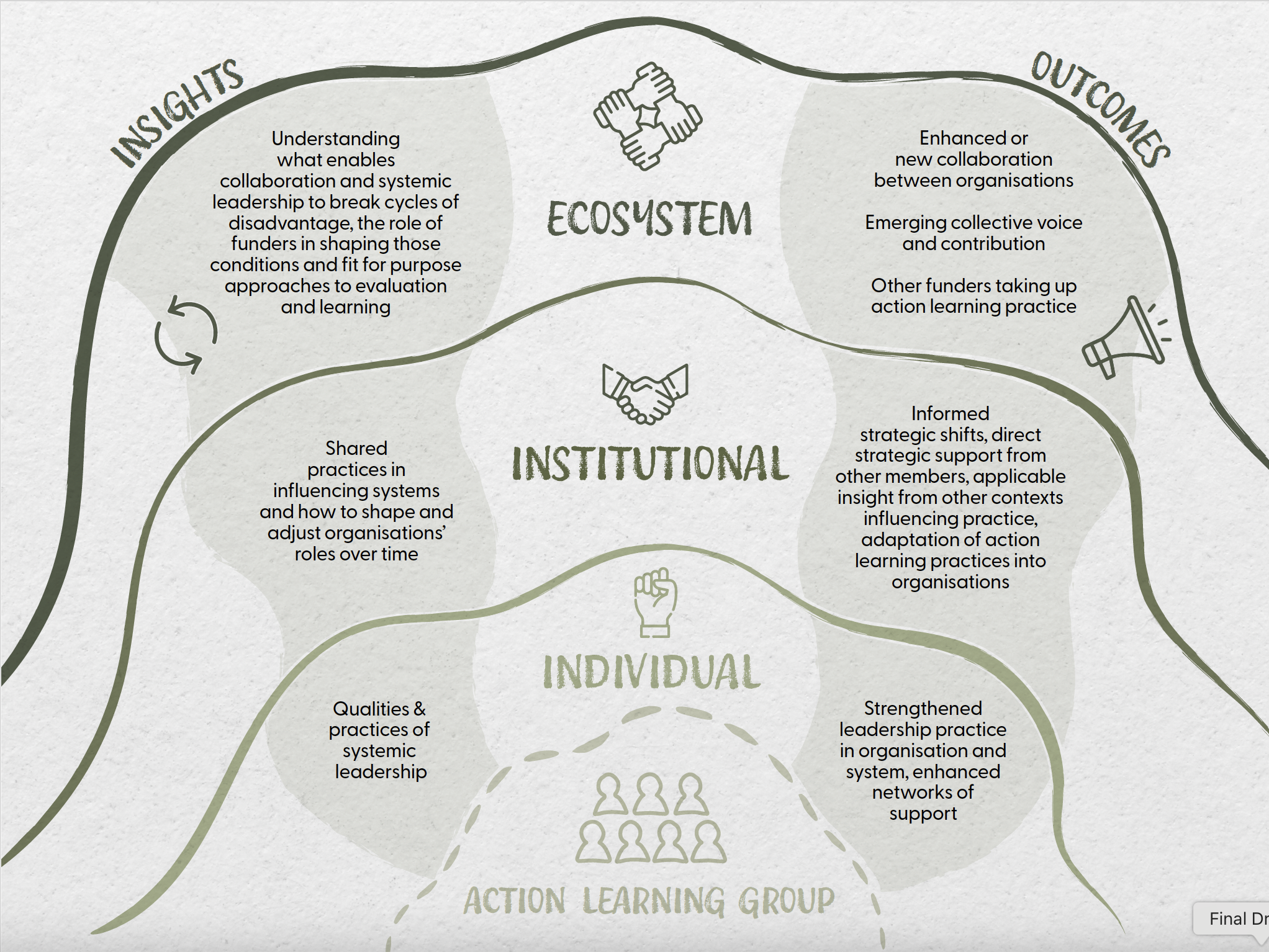
Infographic of types of insights and outcomes emerging from 3 years of Action Learning amongst groups of a Foundation’s partners.
If you’re doing complex work or moving through a transition, and looking for spaciousness, stimulation and community, our Community of Practice offers a place in an Action Learning Set of your own. And if your network, coalition or Foundation’s partner network could do with more leadership and learning support, please get in touch.